In computer networking, routers are like traffic managers. They decide the best path for data packets to travel from one network to another. But how do routers know which path is the best? That’s where routing protocols come in.
A routing protocol is a set of rules that helps routers exchange information and make routing decisions automatically. Without routing protocols, networks would require manual configuration for every possible route, which is not practical in today’s large and complex environments.
Think of it like GPS navigation: you provide the destination, and GPS finds the best route, avoids traffic, and updates automatically if roads are blocked. Routing protocols do the same job for data packets.
What Are Routing Protocols?
A routing protocol is not the same as routing itself.
- Routing is the actual process of moving packets from source to destination. It’s the job of the router to forward data.
- Routing protocol is the set of rules routers use to communicate with each other, advertise routes, learn about network changes, and decide the best path.
In simple words: Routing is the job, routing protocol is the guidebook.
Routers use algorithms and metrics (like hop count, bandwidth, or delay) to select the most efficient path. This ensures that even in the case of a link failure, data can still reach its destination through an alternate path.
Types of Routing Protocols
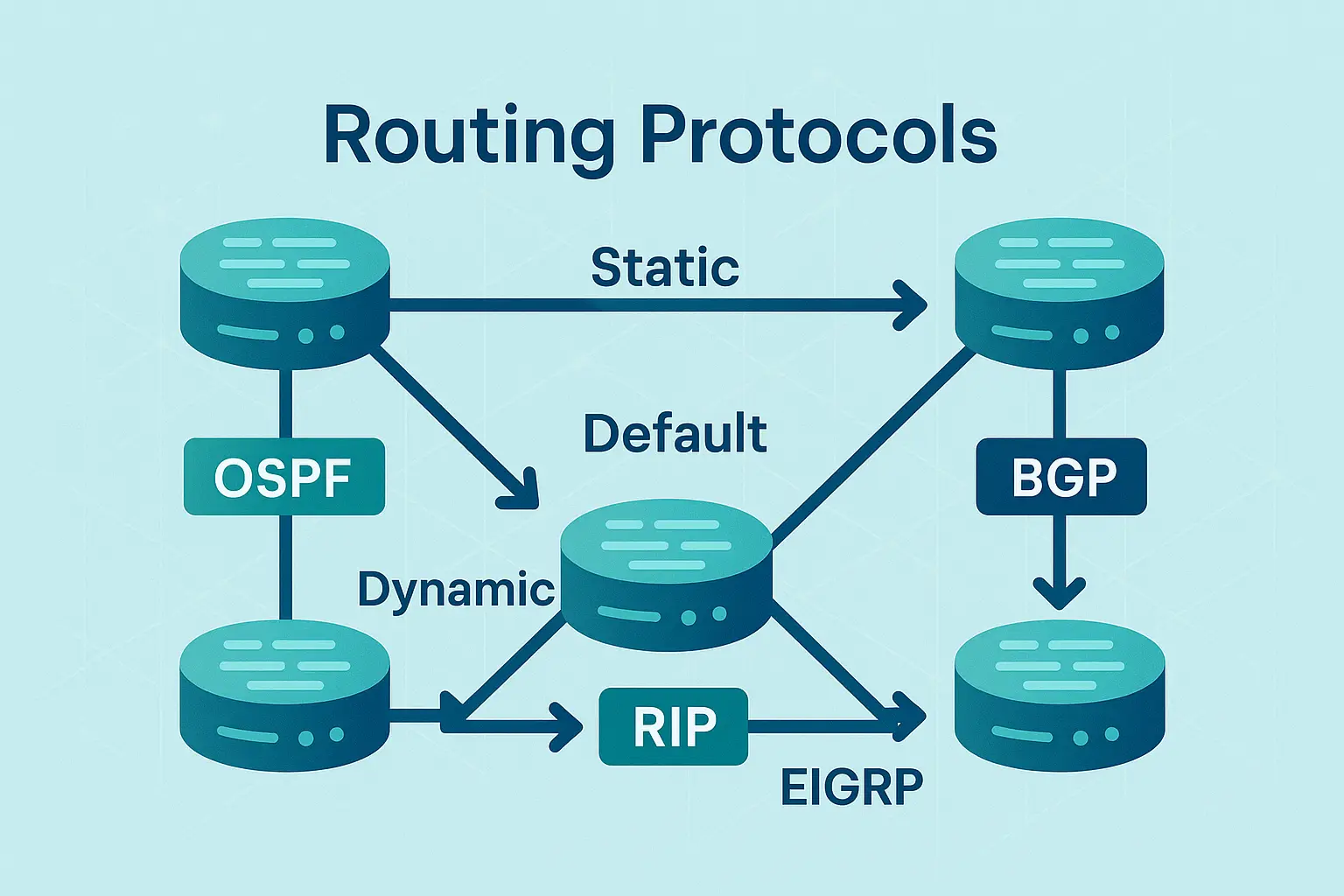
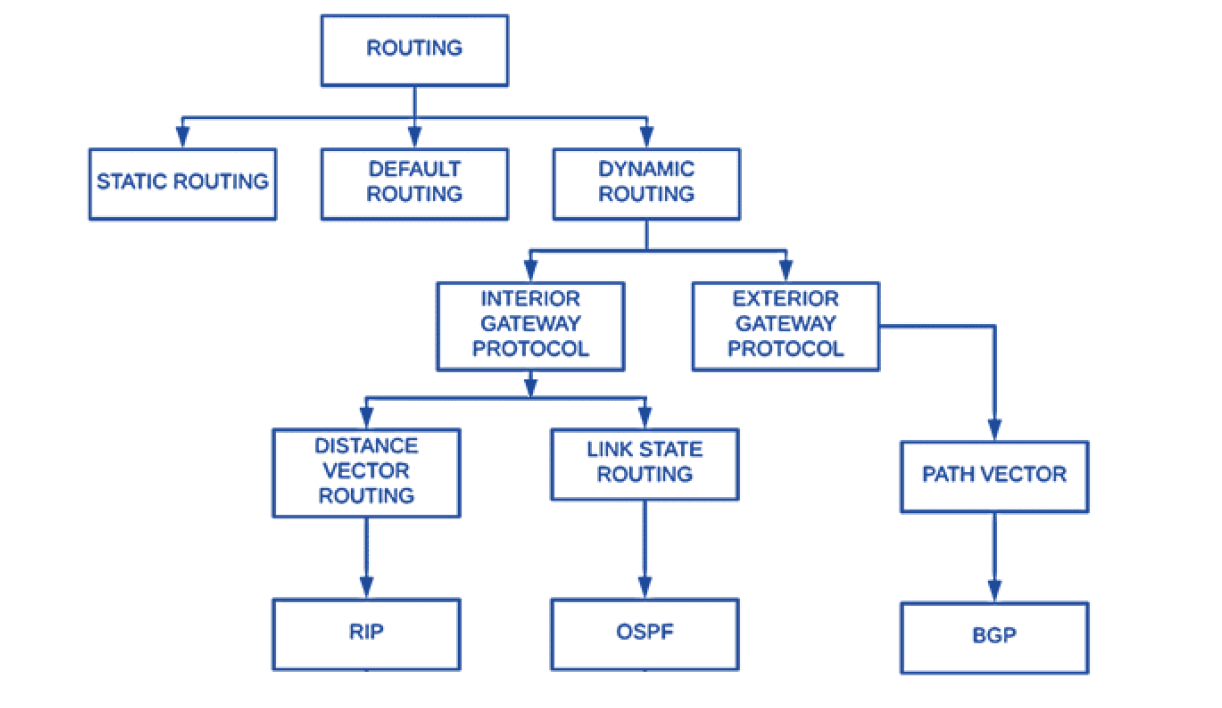
Routing protocols can be broadly classified into three types: Static, Default, and Dynamic.
Static Routing
Static routing means the administrator manually enters routes into the router’s routing table.
- How it works: Each destination network and its next-hop address are configured by hand. If a new network is added or a link fails, the administrator must manually update the router.
- Advantages:
- Simple to configure in small networks
- Very predictable (no unexpected route changes)
- Consumes no router CPU resources for updates
- Disadvantages:
- Not scalable — becomes unmanageable in large networks
- No automatic failover if a link goes down
- Human error in configuration can cause downtime
- Example use case: A small branch office router that only connects to the headquarters router. Since there is only one possible path, static routes are simple and effective.
Default Routing
A default route is a “catch-all” route used when the router doesn’t know where to forward a packet.
- How it works: Instead of maintaining routes to every possible network, a default route forwards all unknown traffic to a single next-hop. This is usually the ISP’s router.
- Advantages:
- Reduces routing table size significantly
- Very easy to configure for edge devices
- Ideal for stub networks (networks with only one exit point)
- Disadvantages:
- Provides no redundancy by itself
- If the default next-hop fails, all traffic will be dropped
- Example use case: Your home Wi-Fi router. It has a default route pointing to your ISP’s gateway, and all internet traffic is sent there. The router doesn’t need to know about the millions of subnets on the internet.
Dynamic Routing Protocols
Dynamic routing protocols allow routers to learn routes automatically and update them as the network changes.
- How it works: Routers periodically share updates about known networks with their neighbors. They use algorithms to calculate the shortest or most efficient path and update their routing tables accordingly. If a link fails, they quickly adapt by finding an alternate route.
- Advantages:
- Highly scalable for large networks with frequent changes
- Provides redundancy and automatic failover
- Reduces the need for manual configuration
- Disadvantages:
- More CPU and memory usage on routers (due to calculations and updates)
- Requires careful design to avoid routing loops or convergence issues
- More complex to configure compared to static routes
- Example use case: Large enterprise networks or ISPs where dozens or hundreds of routers must stay in sync with real-time updates.
Dynamic routing protocols are divided into Interior Gateway Protocols (IGPs) and Exterior Gateway Protocols (EGPs).
Categories of Dynamic Routing Protocols
Interior Gateway Protocols (IGPs)
IGPs work within a single organization or autonomous system (AS). They are designed for internal routing.
There are two main types of IGPs:
1. Distance Vector Routing Protocols
Distance vector protocols determine the best path based on distance (hop count) and direction (next-hop router). Each router shares its entire routing table with its directly connected neighbors at regular intervals.
- RIP (Routing Information Protocol)
- RIPv1: Introduced in the 1980s, supports classful routing only (no subnet masks). This is now obsolete.
- RIPv2: Adds classless routing support (CIDR), subnet masks, and authentication. Still limited to a maximum of 15 hops.
- Limitations: Due to the hop count restriction, RIP is not suitable for large networks. It also converges slowly when network changes occur.
- EIGRP (Enhanced Interior Gateway Routing Protocol)
- Originally Cisco proprietary, later became an open standard.
- Uses multiple metrics for route selection: bandwidth, delay, load, and reliability.
- Converges faster than RIP and provides better scalability.
- Supports unequal-cost load balancing, which allows more efficient use of multiple links.
2. Link-State Routing Protocols
Link-state protocols take a different approach. Instead of sharing their entire routing table, routers exchange information about the state of their links (interfaces). Each router builds a complete map of the network topology and independently calculates the shortest path using the Dijkstra SPF (Shortest Path First) algorithm.
- OSPF (Open Shortest Path First)
- An open standard widely used in enterprise networks.
- Supports VLSM (Variable Length Subnet Masking) and CIDR.
- Divides the network into areas to improve scalability and reduce processing overhead.
- Has faster convergence compared to distance vector protocols.
- IS-IS (Intermediate System to Intermediate System)
- Developed by ISO, often used in service provider networks.
- Similar in design to OSPF but works directly with CLNP as well as IP.
- Known for scalability and stability in large ISP backbones.
- More flexible in handling large and hierarchical topologies.
Exterior Gateway Protocols (EGPs)
EGPs are used for exchanging routing information between different autonomous systems (ASes).
- BGP (Border Gateway Protocol)
- The protocol that literally powers the Internet.
- Uses a path vector routing method, which considers AS-path, policies, and various attributes to decide the best route.
- Scales globally, supporting thousands of routes with stable convergence.
- Highly customizable — network operators can apply policies to control which routes are advertised or accepted.
- Used by ISPs and large enterprises to connect to multiple providers and ensure reliable internet routing.
Key Differences Between Static, Default, and Dynamic Routing
| Feature | Static Routing | Default Routing | Dynamic Routing |
|---|---|---|---|
| Configuration | Manual (per route) | One catch-all route | Automatic via routing protocol |
| Scalability | Low | Medium (good for stubs) | High (enterprise/ISP level) |
| Adaptability | None | Limited | High (auto-adjusts to changes) |
| Overhead | None | Very low | Higher CPU/memory usage |
| Convergence | No (manual change only) | No (relies on default path) | Fast (auto recalculations) |
| Use Case | Small static networks | Home/edge routers to ISP | Large enterprise & ISP networks |
Real-World Examples
- Static Routing: A small branch router that has only one uplink to headquarters. Since the route never changes, static configuration is perfect.
- Default Routing: Your home Wi-Fi router forwarding all unknown traffic to your ISP. It doesn’t need full internet routes.
- Dynamic Routing: An enterprise with hundreds of routers across multiple campuses. Internally, OSPF is used for quick convergence, while BGP is used at the edge to exchange routes with different ISPs.
Conclusion
Routing protocols are the backbone of modern networking. From simple static routes in small offices to complex BGP setups powering the internet, they ensure data always finds the best path.
For network engineers and firewall administrators, understanding these protocols is essential. Whether you’re configuring OSPF in an enterprise or handling BGP on an ISP edge router, routing protocols decide how efficiently and reliably your network runs.
By mastering the concepts of static, default, and dynamic routing protocols, you gain the foundation needed to troubleshoot, optimize, and secure enterprise networks.
📌 Read More

Cybersecurity blogger with a focus on firewalls, network security, and tech trends making security simple for everyone, from IT pros to curious minds.